
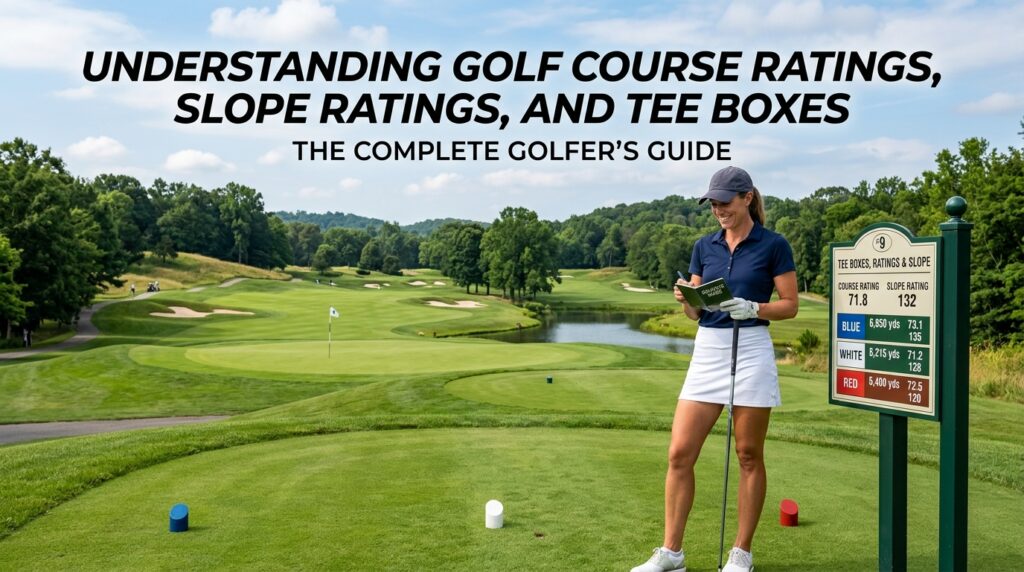
Every golf course presents unique challenges, but not every golfer experiences those challenges the same way. That’s why golf uses Course Rating, Slope Rating, and multiple tee boxes to measure difficulty and help players choose the most appropriate course setup.
Understanding these numbers allows golfers to select the correct tees, estimate course difficulty, calculate handicaps accurately, improve course management, and enjoy a better overall golfing experience.
Whether you’re a beginner learning the basics or an experienced golfer trying to lower your scores, understanding how these systems work can help you make smarter decisions before every round.
Quick Answer
What do golf course rating, slope rating, and tee boxes mean?
Course Rating estimates the score a scratch golfer is expected to shoot under normal conditions. Slope Rating measures how much more difficult a course is for a bogey golfer compared to a scratch golfer. Tee boxes provide different course lengths so golfers of varying skill levels and driving distances can play from the most appropriate starting point.
Why These Numbers Matter More Than Most Golfers Realize
Many golfers glance at the scorecard, note the yardage, and head to the first tee without paying attention to the course rating or slope rating.
That often leads to unrealistic expectations, poor tee selection, slower rounds, and unnecessary frustration.
These numbers aren’t just statistics. They help golfers:
- Choose tees that match their abilities.
- Compare scores fairly across different courses.
- Understand why one course feels harder than another.
- Improve course management decisions.
- Track handicap performance accurately.
- Enjoy a more rewarding round of golf.
Learning how to interpret these measurements helps you play smarter, not just harder.
Why Golf Uses a Standardized Rating System
Imagine shooting an 84 on two different golf courses.
Without a standardized system, both scores would appear identical.
In reality:
- One course may be short with wide fairways and few hazards.
- Another may feature long holes, fast greens, water hazards, and narrow landing areas.
The scoring challenge isn’t the same.
That’s why the golf industry developed standardized course ratings and slope ratings to evaluate difficulty consistently and make handicaps more accurate.
Benefits of Understanding Golf Ratings
| Benefit | Why It Matters |
|---|---|
| Better Tee Selection | Matches course length to your ability |
| Accurate Handicap Calculations | Creates fair competition |
| Smarter Course Management | Improves decision-making |
| More Enjoyable Golf | Reduces unnecessary frustration |
| Faster Pace of Play | Encourages golfers to play appropriate tees |
| Better Score Expectations | Helps set realistic goals |
Golf Course Rating System at a Glance
| Measurement | Purpose |
|---|---|
| Course Rating | Difficulty for a scratch golfer |
| Slope Rating | Difficulty for a bogey golfer relative to a scratch golfer |
| Yardage | Total course length |
| Tee Boxes | Different starting distances for varying abilities |
| Handicap Index | Measures a golfer’s demonstrated playing ability |
Together, these measurements provide a complete picture of how challenging a course is likely to play.
What Is a Golf Course Rating?
A Course Rating represents the score that a scratch golfer is expected to shoot under normal playing conditions.
A scratch golfer typically has:
- A Handicap Index of 0.0
- Consistent ball striking
- Strong course management
- The ability to play at or near par
For example:
- Par: 72
- Course Rating: 72.8
This means a scratch golfer would be expected to average approximately 72.8 strokes.
If another course has:
- Par: 72
- Course Rating: 75.1
That course presents a significantly greater challenge for highly skilled players.
What Factors Affect Course Rating?
Course rating is calculated using a wide range of physical and strategic characteristics.
Length
Longer courses generally increase the rating because approach shots become more demanding.
Obstacles
Difficulty increases with:
- Water hazards
- Fairway bunkers
- Trees
- Thick rough
- Out-of-bounds areas
Green Complexity
Course ratings often rise when greens include:
- Multiple tiers
- Fast speeds
- Severe slopes
- Difficult pin positions
Elevation Changes
Uphill and downhill shots affect club selection and overall difficulty.
Environmental Conditions
Prevailing winds, forced carries, and landing areas may also influence course ratings.
Expert Golf Tip
Many golfers assume yardage alone determines how difficult a course is.
In reality, strategy, hazards, green design, and shot values often have an even greater influence than total distance.
A shorter course with demanding greens and well-positioned hazards may play considerably harder than a longer, more forgiving layout.
Featured Snippet
What is a golf course rating?
A golf course rating is a numerical value that estimates the score a scratch golfer is expected to shoot under normal playing conditions. It measures the overall playing difficulty of a course for highly skilled golfers and serves as one of the key components used in the golf handicap system.
Common Beginner Mistakes
Avoid these misconceptions:
❌ Assuming longer courses are always harder.
❌ Ignoring the course rating when selecting tees.
❌ Comparing scores from different courses without considering ratings.
❌ Choosing tee boxes based on ego instead of driving distance.
❌ Believing handicap calculations only depend on score.
Professional Golf Insight
Experienced golfers don’t judge a course by yardage alone.
Before every round, they evaluate the course rating, slope rating, tee options, weather conditions, and course setup to develop realistic expectations and smarter playing strategies.
Understanding these details before your first tee shot often leads to better decision-making throughout the round.
Understanding Slope Rating: Why the Same Course Feels Harder for Different Golfers
While Course Rating measures the expected score for a scratch golfer, Slope Rating answers a different question:
How much more difficult is this course for the average golfer compared to a scratch golfer?
This measurement recognizes an important reality of golf.
Not every golfer is affected by hazards, distance, rough, and green complexity in the same way.
A scratch golfer may navigate a narrow fairway with little trouble, while a higher-handicap player may face multiple recovery shots before reaching the green.
That’s exactly what Slope Rating measures.
What Is a Slope Rating?
A Slope Rating measures the relative difficulty of a golf course for a bogey golfer compared to a scratch golfer.
Unlike Course Rating, which predicts scoring ability for elite players, Slope Rating focuses on how much additional difficulty average golfers experience.
Who Is a Bogey Golfer?
Under the World Handicap System:
Male Bogey Golfer
- Handicap Index around 20
- Average driving distance: approximately 200 yards
Female Bogey Golfer
- Handicap Index around 24
- Average driving distance: approximately 150 yards
These golfers represent the majority of recreational players.
Slope Rating Scale Explained
Slope Rating ranges from:
| Rating | Difficulty |
|---|---|
| 55–90 | Easy |
| 91–113 | Average |
| 114–130 | Moderately Difficult |
| 131–155 | Very Challenging |
The standard slope rating is 113.
Courses rated above 113 are more difficult than average.
Courses rated below 113 are generally easier for recreational golfers.
What Different Slope Ratings Feel Like
Slope Rating: 55–90
These are among the easiest golf courses.
Typical characteristics include:
- Wide fairways
- Few hazards
- Flat greens
- Limited rough
- Short overall yardage
Ideal for:
- Beginners
- Juniors
- Casual golfers
- Learning the game
Slope Rating: 91–113
This represents average golf course difficulty.
Many municipal and public golf courses fall into this range.
Players experience:
- Balanced challenge
- Moderate hazards
- Fair landing areas
- Reasonable green speeds
Slope Rating: 114–130
These courses demand better decision-making.
Golfers must carefully manage:
- Club selection
- Tee shot placement
- Recovery shots
- Green reading
Mistakes become more costly.
Slope Rating: 131–155
These are among the most demanding courses.
Common features include:
✔ Narrow fairways
✔ Thick rough
✔ Numerous bunkers
✔ Forced carries
✔ Water hazards
✔ Fast greens
✔ Significant elevation changes
These courses reward precision far more than power.
Why Slope Rating Matters
Two golf courses may have identical pars and nearly identical Course Ratings.
Yet one may feel dramatically harder for recreational golfers.
That’s because:
Scratch golfers often recover from mistakes.
Bogey golfers usually lose more strokes after errors.
Slope Rating measures that difference.
Example Comparison
Course A
- Par: 72
- Course Rating: 72.3
- Slope Rating: 113
This represents average difficulty.
Course B
- Par: 72
- Course Rating: 72.5
- Slope Rating: 138
Although both courses appear similar for elite golfers, Course B becomes significantly more demanding for average players because hazards punish inconsistent shots more severely.
Course Rating vs Slope Rating
Many golfers confuse these two measurements.
They’re related but not interchangeable.
| Course Rating | Slope Rating |
|---|---|
| Measures difficulty for scratch golfers | Measures difficulty for bogey golfers |
| Expected scratch golfer score | Relative difficulty increase |
| Usually between 67–77 | Always between 55–155 |
| Based on scratch performance | Based on scratch vs bogey comparison |
Together, they provide a more complete understanding of course difficulty.
Why Two Golfers Can Shoot the Same Score Differently
Imagine two golfers each shoot 88.
Golfer A plays:
- Course Rating: 69.8
- Slope: 111
Golfer B plays:
- Course Rating: 74.5
- Slope: 139
Although both players scored 88, Golfer B’s performance may be stronger because the course presented a much greater challenge.
That’s why handicaps adjust scores based on course difficulty.
Scratch Golfer vs Bogey Golfer
| Category | Scratch Golfer | Bogey Golfer |
|---|---|---|
| Handicap | 0 | Around 20–24 |
| Driving Distance | 250–280+ yards | 150–200 yards |
| Greens in Regulation | Frequently | Occasionally |
| Course Management | Advanced | Developing |
| Recovery Skills | Excellent | Moderate |
| Scoring Consistency | High | Variable |
Understanding where your game fits helps you choose more appropriate tee boxes and set realistic expectations.
How Slope Rating Influences Handicap
The World Handicap System doesn’t evaluate scores in isolation.
Instead, it considers:
- Your score
- Course Rating
- Slope Rating
- Playing Conditions
This creates fair comparisons across different golf courses.
Without Slope Rating:
- Shooting 85 on an easy course
- Shooting 85 on a championship course
would appear identical.
In reality, they represent very different performances.
Why Handicap Adjustments Matter
Golfers often travel and play unfamiliar courses.
Slope Rating allows players from different clubs and regions to compete fairly because the difficulty of each course is built into handicap calculations.
This is one reason the World Handicap System works effectively across thousands of golf courses worldwide.
Expert Golf Tip
Don’t judge a golf course solely by its total yardage.
Before booking your tee time, review:
- Course Rating
- Slope Rating
- Total Yardage
- Tee Options
- Hazard Placement
- Green Speeds
A shorter course with a Slope Rating of 138 may play significantly tougher than a longer course with a Slope Rating of 116.
Common Myths About Slope Rating
Myth 1
Higher slope always means longer course.
❌ False.
Hazards, rough, green design, and forced carries often increase slope more than yardage.
Myth 2
Only low handicappers should care about slope.
❌ False.
Slope Rating was created specifically to reflect how courses affect average golfers.
Myth 3
Courses with identical ratings play the same.
❌ False.
Layout, wind, hazards, and strategy all influence how a course feels.
Featured Snippet
What is a slope rating in golf?
Slope Rating measures how much more difficult a golf course is for a bogey golfer compared with a scratch golfer. The scale ranges from 55 to 155, with 113 representing average difficulty. Higher slope ratings indicate that average golfers will find the course significantly more challenging.
Course Rating tells you:
“How difficult is this course for an expert golfer?”
Slope Rating tells you:
“How much harder will this course be for the average golfer?”
Understanding both measurements helps golfers:
- Choose appropriate tee boxes.
- Set realistic scoring expectations.
- Interpret handicap calculations correctly.
- Compare courses more accurately.
Professional Golf Instructor Insight
One of the most common mistakes golfers make is choosing a course or tee box based solely on yardage.
Experienced instructors encourage players to evaluate the complete picture, including Course Rating, Slope Rating, hazards, elevation changes, and driving distance.
Playing a course that matches your current skill level creates more confidence, improves pace of play, and makes every round more enjoyable.
Understanding Tee Boxes: Why Playing the Right Tees Improves Every Round
After learning about Course Rating and Slope Rating, the next step is understanding tee boxes.
Many golfers mistakenly believe tee boxes are determined by age or gender.
In reality, the best tee box is determined by your driving distance, consistency, handicap, and overall skill level.
Choosing the appropriate tees helps golfers:
- Enjoy the course as it was designed.
- Reach greens in regulation more often.
- Improve pace of play.
- Lower frustration.
- Develop better course management habits.
- Build confidence throughout the round.
What Is a Tee Box?
A tee box, or teeing area, is the designated starting location for each hole.
Every golf course offers multiple tee boxes positioned at different distances from the hole, allowing golfers of varying abilities to play a course that’s appropriate for their game.
Although the colors vary between clubs, the purpose remains the same:
Provide multiple course lengths that accommodate different playing abilities.
Typical Tee Box Colors
| Tee Color | Common Player Type | Typical Yardage |
|---|---|---|
| Black | Championship / Professionals | Longest |
| Blue | Low Handicap Golfers | Very Long |
| White | Average Golfers | Standard |
| Gold | Senior Golfers | Shorter |
| Red | Beginners & Recreational Golfers | Short |
| Green (when available) | Juniors / Learning Programs | Shortest |
Important: Tee colors are not universal. Always check the scorecard because every golf course may use different colors and yardages.
The Purpose of Multiple Tee Boxes
The golf course architect designs each hole around specific landing zones, approach shots, and strategic decisions.
When golfers play tees that are too long:
- Fairway bunkers become unreachable.
- Forced carries become intimidating.
- Long irons replace short irons into greens.
- Pace of play slows.
- Frustration increases.
Playing the correct tees allows golfers to experience each hole as intended.
Why Driving Distance Matters More Than Handicap
Many golfers assume handicap alone determines tee selection.
While handicap is helpful, average driving distance often provides a better starting point.
Recommended Tee Boxes by Driving Distance
| Average Driver Distance | Suggested Course Length |
|---|---|
| Under 150 yards | 4,000–4,800 yards |
| 150–180 yards | 4,800–5,400 yards |
| 180–210 yards | 5,400–5,900 yards |
| 210–240 yards | 5,900–6,400 yards |
| 240–270 yards | 6,400–6,900 yards |
| 270+ yards | 6,900+ yards |
This approach keeps approach shots realistic and preserves the intended strategy of each hole.
Ability-Based Tee Selection Guide
Beginner Golfers
Recommended:
- Forward tees
- Shorter course yardage
- Lower stress
- More scoring opportunities
Benefits:
✔ Faster learning
✔ Better confidence
✔ Improved pace of play
Intermediate Golfers
Recommended:
- Middle tees
Focus on:
- Shot consistency
- Course management
- Distance control
Low Handicap Golfers
Recommended:
- Championship or back tees (only if driving distance supports it)
Goals:
- Strategic shot placement
- Advanced course management
- Competitive preparation
Senior Golfers
As driving distance naturally changes over time, many senior golfers improve their enjoyment by moving to shorter tees.
Benefits include:
- More greens in regulation
- Less fatigue
- Better scoring opportunities
- More enjoyable rounds
Junior Golfers
Junior players should always prioritize skill development over distance.
Forward tees allow young golfers to:
- Learn strategy.
- Build confidence.
- Develop proper swing mechanics.
- Experience success early.
Why Playing the Wrong Tees Hurts Your Game
Choosing tees based on pride instead of ability creates unnecessary difficulty.
Common Problems
Longer Approach Shots
Instead of hitting a pitching wedge into the green, golfers may face long irons or hybrids.
More Penalty Strokes
Longer carries increase encounters with:
- Water hazards
- Fairway bunkers
- Thick rough
Slower Pace of Play
Repeated recovery shots delay play for everyone on the course.
Lower Confidence
Constantly struggling to reach greens often reduces enjoyment and confidence.
Tee Selection Comparison
| Correct Tees | Incorrect Tees |
|---|---|
| Realistic approach shots | Long difficult approaches |
| Better pace of play | Slower rounds |
| Higher confidence | Increased frustration |
| Better scoring | More penalty strokes |
| More enjoyable golf | Less enjoyable experience |
Course Rating Changes With Every Tee
Many golfers don’t realize that Course Rating and Slope Rating change depending on which tees you play.
Example:
| Tee | Course Rating | Slope |
|---|---|---|
| Black | 74.8 | 142 |
| Blue | 72.9 | 136 |
| White | 70.6 | 128 |
| Gold | 68.2 | 119 |
| Red | 66.0 | 112 |
This reflects the changing difficulty as the course becomes shorter.
Always review the scorecard for ratings specific to your chosen tee.
Pace of Play Benefits
Playing from appropriate tees benefits everyone.
Advantages include:
✔ Faster rounds
✔ Fewer lost balls
✔ Less waiting
✔ More enjoyable golf
✔ Better course flow
✔ Improved player satisfaction
Many golf organizations now encourage players to choose tees based on driving distance rather than tradition.
The “Tee It Forward” Philosophy
The “Tee It Forward” concept encourages golfers to select tees that match their average driving distance.
Rather than viewing shorter tees as easier, the philosophy promotes:
- Better strategy
- More approach shots with scoring clubs
- Increased birdie opportunities
- Greater enjoyment
- Improved pace of play
This initiative has become increasingly popular because it helps golfers experience the course as designers intended.
How Tee Selection Affects Course Strategy
Changing tees changes more than total yardage.
It also influences:
- Club selection
- Landing areas
- Risk vs reward decisions
- Shot angles
- Green approaches
- Scoring opportunities
For example, a reachable par 5 from the white tees may require three shots from the championship tees.
Understanding this helps golfers develop smarter course management strategies.
Common Tee Box Mistakes
Avoid these common errors:
❌ Choosing tees because friends are playing them.
❌ Assuming younger golfers should always play farther back.
❌ Ignoring driving distance.
❌ Moving back after one good round.
❌ Believing shorter tees are only for beginners.
❌ Selecting tees based solely on ego.
Featured Snippet
Which tee box should I play in golf?
The best tee box is determined by your average driving distance, consistency, and overall ability rather than age or gender. Playing the appropriate tees helps golfers reach greens in regulation more often, improve pace of play, build confidence, and enjoy the course as it was designed to be played.
Choose tees based on:
- Average driving distance
- Ball striking consistency
- Handicap
- Confidence level
- Desired pace of play
Avoid choosing tees based on pride or tradition.
Professional Golf Instructor Insight
One of the fastest ways to improve your golf experience isn’t buying new clubs or changing your swing.
It’s choosing the right tee box.
Golf instructors consistently observe that players who move forward to tees that match their distance enjoy lower scores, quicker rounds, better confidence, and more strategic decision-making.
Golf becomes significantly more enjoyable when you’re hitting clubs into greens that the course architect originally intended.
Players who want to build consistency can also follow a structured golf practice schedule that balances swing work, short-game training, putting, and on-course play.
Understanding Course Rating, Slope Rating, and Tee Boxes allows golfers to make smarter decisions before every round.
These three measurements work together to help golfers:
- Choose appropriate tee boxes.
- Understand course difficulty.
- Calculate handicaps accurately.
- Improve course management.
- Enjoy a faster pace of play.
- Build confidence by playing the course as it was designed.
Whether you’re playing your home course or visiting a new golf destination, knowing how to interpret these numbers helps you set realistic expectations and play more strategically.
Key Takeaways
✔ Course Rating estimates the score a scratch golfer should shoot.
✔ Slope Rating measures how much more difficult a course is for a bogey golfer than a scratch golfer.
✔ 113 is the standard slope rating.
✔ Tee boxes should be selected based on driving distance and ability, not age or ego.
✔ Every tee box has its own Course Rating and Slope Rating.
✔ Playing the correct tees improves pace of play and overall enjoyment.
✔ Understanding these ratings makes handicap calculations more accurate.
Golf Rating Quick Reference
| Golf Term | Meaning |
|---|---|
| Course Rating | Expected score for a scratch golfer |
| Slope Rating | Relative difficulty for a bogey golfer |
| Handicap Index | Measures playing ability |
| Tee Box | Starting point that determines course length |
| Yardage | Total distance from tee to green |
Golf Course Difficulty Comparison
| Feature | Easier Course | Difficult Course |
|---|---|---|
| Fairways | Wide | Narrow |
| Rough | Light | Thick |
| Water Hazards | Few | Frequent |
| Bunkers | Limited | Strategic |
| Greens | Large & Flat | Small & Fast |
| Elevation | Minimal | Significant |
| Forced Carries | Rare | Common |
| Slope Rating | 105–113 | 130–155 |
Beginner Golfer Checklist
Before every round, ask yourself:
☐ Which tee box matches my driving distance?
☐ What is today’s Course Rating?
☐ What is the Slope Rating?
☐ What hazards appear on the scorecard?
☐ Which holes require conservative strategy?
☐ Is today’s weather affecting course difficulty?
☐ What’s my realistic scoring goal?
Preparing before you tee off often leads to better decisions throughout the round.
Tee Selection Worksheet
Use this guide to choose the most appropriate starting tees.
| Question | Yes | No |
|---|---|---|
| Can I consistently reach par 4s in regulation? | ☐ | ☐ |
| Do I average the recommended driving distance? | ☐ | ☐ |
| Am I playing comfortably rather than struggling? | ☐ | ☐ |
| Does my pace of play remain consistent? | ☐ | ☐ |
| Am I enjoying the course? | ☐ | ☐ |
If several answers are “No,” consider moving to a shorter set of tees.
How to Read a Golf Scorecard
A scorecard contains far more information than just par and yardage.
Look for:
- Hole-by-hole yardage
- Par
- Handicap stroke index
- Tee colors
- Course Rating
- Slope Rating
- Local rules
- Out-of-bounds markings
Understanding every section of the scorecard helps you create a smarter game plan before the first shot.
Scorecard Example
| Hole | Par | White Tee | Blue Tee |
|---|---|---|---|
| 1 | 4 | 365 yds | 398 yds |
| 2 | 5 | 515 yds | 548 yds |
| 3 | 3 | 165 yds | 188 yds |
Notice how changing tees affects club selection and overall strategy without changing the design of the hole.
Course Management Tips Based on Ratings
If you’re playing a course with:
High Course Rating
Focus on:
- Conservative targets
- Avoiding penalty strokes
- Smart club selection
- Patience
High Slope Rating
Prioritize:
- Keeping the ball in play
- Avoiding unnecessary risks
- Playing for position rather than distance
- Managing expectations
Lower Slope Rating
Take advantage of:
- More scoring opportunities
- Aggressive but calculated play
- Confidence with approach shots
Common Mistakes Golfers Make
Avoid these common errors:
🚫 Choosing tee boxes based on pride instead of ability.
🚫 Comparing scores from different courses without considering ratings.
🚫 Assuming all par-72 courses play the same.
🚫 Ignoring Slope Rating before calculating performance.
🚫 Playing championship tees without sufficient distance.
🚫 Focusing only on total yardage.
🚫 Overlooking hazards shown on the scorecard.
🚫 Setting unrealistic scoring expectations.
Professional Playing Tips
Experienced golfers typically:
- Review the scorecard before every round.
- Choose tees that match their average driving distance.
- Develop a strategy for difficult holes before teeing off.
- Respect the Course Rating and Slope Rating rather than relying on yardage alone.
- Adjust expectations based on course conditions, weather, and setup.
Preparation often leads to smarter decisions and lower scores.
FAQs
1. What is a golf course rating?
A Course Rating estimates the score a scratch golfer is expected to shoot under normal playing conditions.
2. What is a slope rating?
Slope Rating measures how much more difficult a golf course is for a bogey golfer compared to a scratch golfer.
3. What is the average slope rating?
The standard Slope Rating is 113, representing average course difficulty.
4. Is a higher slope rating harder?
Yes. A higher Slope Rating generally indicates that the course is more challenging for higher-handicap golfers.
5. What is considered a difficult golf course?
Courses with Slope Ratings above 130 are generally considered challenging for recreational golfers.
6. Should beginners play forward tees?
Yes. Forward tees make the course more manageable, improve confidence, and support faster pace of play.
7. Are tee colors the same at every golf course?
No. Tee colors vary by facility, so always check the scorecard rather than relying on color alone.
8. Why does every tee have a different course rating?
Each tee changes the length, angles, and strategy of the course, which affects overall difficulty.
9. How do ratings affect handicaps?
Course Rating and Slope Rating are used to adjust scores so golfers can compete fairly on courses with different difficulty levels.
10. Is yardage the only factor that determines difficulty?
No. Hazards, green design, rough, elevation, and forced carries also influence difficulty.
11. What is a scratch golfer?
A scratch golfer has a Handicap Index of approximately 0 and is expected to play at or near par.
12. What is a bogey golfer?
A bogey golfer generally has a Handicap Index around 20 (men) or 24 (women) and represents an average recreational player.
13. Why do golf courses have multiple tee boxes?
Multiple tees allow golfers of different skill levels and driving distances to enjoy the course appropriately.
14. Should seniors always play senior tees?
Not necessarily. Tee selection should be based on current driving distance and ability rather than age.
15. Can lower handicappers play shorter tees?
Absolutely. Many skilled golfers play forward tees for practice, variety, or faster rounds.
16. Does weather affect course difficulty?
Yes. Wind, rain, temperature, and course firmness can significantly change how a course plays.
17. How do I know which tee box is right for me?
Start with your average driving distance, consistency, and ability to reach par 4 greens in regulation.
18. Why is pace of play important?
Playing the correct tees helps reduce delays, improves enjoyment, and creates a better experience for everyone on the course.
19. Can two golfers shoot the same score but perform differently?
Yes. Course Rating and Slope Rating help explain differences in performance across courses with varying difficulty.
20. How often are course ratings updated?
Golf organizations periodically review and update ratings when course layouts or conditions change significantly.
21. Should I check ratings before booking a tee time?
Yes. Reviewing ratings helps you choose an appropriate challenge and prepare a realistic strategy.
22. What does “Tee It Forward” mean?
It’s an initiative encouraging golfers to play tees that match their driving distance to improve enjoyment and pace of play.
23. Why are greens important in course ratings?
Green speed, slope, size, and contour significantly affect scoring difficulty and influence the Course Rating.
24. Does playing shorter tees make golf easier?
Playing shorter tees makes the course more appropriate for your ability, allowing you to experience its intended design rather than simply making it “easier.”
25. What’s the biggest mistake golfers make regarding tee boxes?
Choosing tees based on ego rather than skill level and driving distance, which often leads to slower play, frustration, and unnecessarily high scores.
How do Course Rating, Slope Rating, and Tee Boxes work together?
Course Rating estimates the expected score for a scratch golfer, Slope Rating measures how much more difficult the course is for a bogey golfer, and tee boxes provide different course lengths to suit players of varying abilities. Together, these systems help golfers choose appropriate tees, calculate handicaps accurately, and enjoy a fairer, more strategic round of golf.
Explore Oaks National Golf Club and use your knowledge of course ratings, slope ratings, and tee boxes to prepare for a more enjoyable round in Kissimmee.