
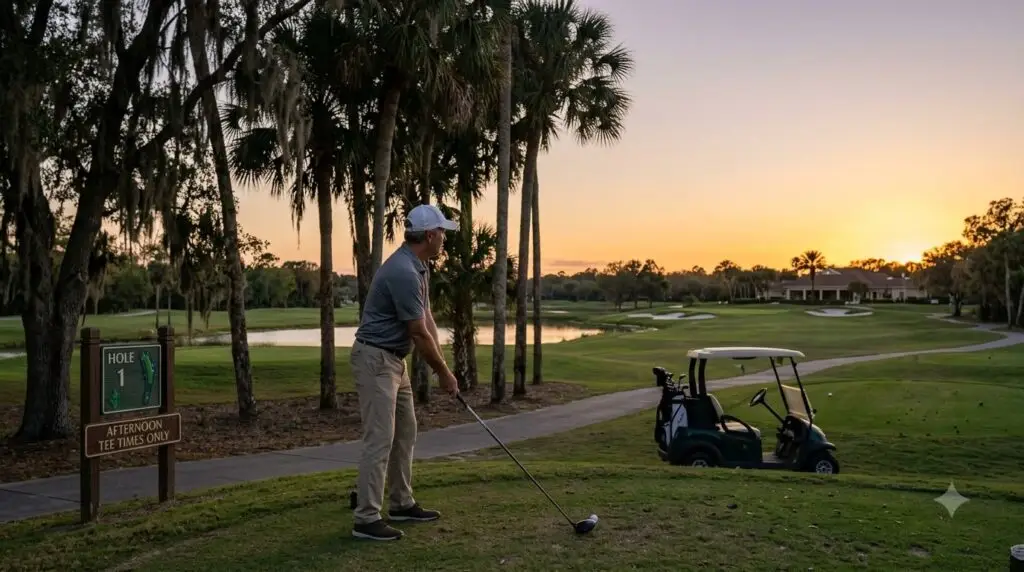
You find an afternoon tee time.
The price looks better than the morning options, your daytime schedule stays open, and 3 PM does not sound particularly late.
Then comes the question that actually matters:
Can you finish all 18 holes before dark?
Near Orlando, the answer changes throughout the year.
A 3 PM tee time can leave a comfortable daylight window during longer late-spring and summer evenings. Put that same tee time on a short winter day and completing 18 at a normal pace may be unrealistic.
The real calculation is:
Tee Time + Expected Round Duration + Delay Risk vs. Sunset
Then add one more Orlando variable:
Weather.
Oaks National Golf Club, in Kissimmee in the greater Orlando area, has an after-3 PM rate category. Posted rates can change and currently include carts.
So before booking twilight golf near Orlando, run the equation.
Quick Answer: Can You Finish 18 Holes After 3 PM?
Sometimes yes. Sometimes no.
A useful starting calculation is:
Estimated Finish Time = Tee Time + Expected Round Duration
Recent USGA research puts the average round around 4 hours and 30 minutes, while also showing that actual pace varies with course traffic, tee spacing, group behavior and accumulated delays.
Using that as a planning estimate:
3:00 PM + 4 hours 30 minutes = 7:30 PM
Now compare 7:30 PM with sunset.
If sunset is 8:25 PM
You have roughly 55 minutes of daylight margin.
Completing 18 is much more realistic if pace and weather cooperate.
If sunset is 7:45 PM
You have only about 15 minutes of margin.
A few delays can erase it.
If sunset is around 5:40 PM
A normal 18-hole round simply does not fit into the available daylight.
That is why 3 PM by itself tells you almost nothing.
The date matters.
The Twilight Tee-Time Equation
Use this before booking:
Step 1: Find Your Actual Tee Time
When will you realistically begin the first hole?
A 3 PM reservation only works mathematically if the round actually starts close to 3 PM.
Step 2: Add a Realistic Round Duration
For planning, around 4 to 4½ hours is a more useful assumption than your fastest round ever.
USGA research shows that pace can also deteriorate later in the day as delays accumulate through the tee sheet.
Step 3: Compare the Finish Time With Sunset
Calculate:
Sunset − Estimated Finish = Daylight Margin
Step 4: Allow for Delay Risk
Possible delays include:
- Groups ahead
- Lost-ball searches
- Cart restrictions
- Course bottlenecks
- Weather interruptions
- A slow turn between nines
- Heavy tee-sheet traffic
Step 5: Check the Weather
In Central Florida, daylight can be perfect while afternoon thunderstorms make the equation irrelevant.
The result you want is not simply:
Estimated finish before sunset
It is:
Estimated finish comfortably before sunset, with conditions that allow play to continue.
Why 3 PM Can Work in Summer but Fail in Winter
Orlando’s available evening daylight changes substantially across the year.
In early January, sunset can occur around the 5:40 PM range.
At the opposite end of the calendar, summer sunsets occur much later.
That creates two completely different rounds.
Short-Day Example
Tee time: 3:00 PM
Sunset: approximately 5:40 PM
Available daylight: roughly 2 hours 40 minutes
A normal 18-hole recreational round does not fit.
Long-Day Example
Suppose sunset is after 8 PM.
Tee time: 3:00 PM
Expected finish: 7:30 PM
Now a full 18 becomes much more realistic.
Same golfer.
Same golf course.
Same 3 PM start.
Different daylight equation.
Seasonal Guide to a 3 PM Tee Time Near Orlando
Use this as a planning guide, not a guarantee.
| Season | Daylight Situation | 3 PM Outlook |
| Winter | Shortest evenings | Full 18 often unrealistic |
| Early Spring | Daylight increasing | Check the exact date |
| Late Spring | Longer evenings | Better chance for 18 |
| Summer | Longest daylight window | Strong daylight potential, higher weather risk |
| Early Fall | Daylight shrinking | Often date-dependent |
| Late Fall | Earlier sunsets | Full 18 becomes increasingly difficult |
The season gives you context.
Your exact sunset gives you the answer.
Winter Twilight Golf: Think in Available Holes
During shorter winter days, trying to force 18 holes into a 3 PM start can create the wrong expectation before you even arrive.
Instead, decide whether you would still enjoy:
- Nine holes
- A shorter practice round
- Playing as many holes as daylight allows
If finishing all 18 is essential, book earlier.
If late-day value matters more than completing a full scorecard, the later tee time may still make sense.
Spring: Recalculate as the Days Get Longer
Spring changes quickly enough that a tee time which feels risky early in the season can become much more workable several weeks later.
Before booking:
- Check the exact sunset
- Estimate your realistic pace
- Review the weather
- Leave some daylight margin
Do not rely on what worked during your last Orlando trip.
Summer: Best Daylight, Biggest Weather Wildcard
Summer gives twilight golfers the longest evening window.
But Central Florida’s warm-season weather adds another variable.
National Weather Service guidance for the region describes the rainy season as warm and humid with frequent showers and thunderstorms. It identifies July through early September as a peak period with heavy rainfall and frequent lightning among the major hazards.
So a summer calculation may say:
Plenty of daylight for 18
while the weather says:
Not today.
Before a summer twilight round, check:
- Hourly forecast
- Thunderstorm risk
- Lightning risk
- Current course conditions
If lightning threatens, completing 18 stops being the priority.
Beyond safety, weather and turf conditions also change how the course plays and how long a round takes.
Fall: Watch the Evening Window Shrink
Fall can catch golfers out because a tee time that worked comfortably several weeks earlier may suddenly become tight.
For example, Orlando sunset on October 31, 2026 is listed around 6:41 PM.
A 3 PM start then provides only about:
3 hours 41 minutes until sunset
That is shorter than the current USGA-reported average round time.
If you play twilight regularly through fall, recalculate rather than relying on habit.
How Much Time Should You Allow for 18 Holes?
There is no universal round time.
Current USGA research cites an average of about 4 hours 30 minutes and explains that golf-course congestion and accumulated delays can slow later groups.
For twilight planning:
Around 3½ to 4 Hours
Possible under favorable, efficient conditions.
Around 4 to 4½ Hours
A more practical planning range for many recreational rounds.
Longer Than 4½ Hours
Possible on busier days or when delays occur.
Do not calculate your tee time using the fastest 18 holes you have ever played.
Use the round you are reasonably likely to play that day.
Why Being a Fast Group Does Not Guarantee a Fast Round
A golfer may think:
“We’re only a twosome. We’ll fly around.”
Maybe.
But a twosome behind several full groups is still behind several full groups.
USGA pace research specifically highlights course congestion, tee-time intervals and groups failing to maintain position as reasons later rounds accumulate delays.
Your group size matters.
The traffic ahead matters too.
For twilight golf, focus on:
keeping pace with the group in front
rather than assuming your own speed controls the entire golf course.
8 Ways to Improve Your Chances of Finishing Before Dark
You cannot control sunset.
You can reduce wasted time.
1. Arrive Early
A twilight round has less room for a delayed start.
Be ready before your tee time with:
- Check-in completed
- Cart loaded
- Clubs organized
- Supplies purchased
- Warm-up completed if desired
Losing ten minutes at the beginning means losing ten minutes of daylight at the end.
2. Play Tees That Fit Your Game
Playing too far back can create:
- Longer approaches
- Difficult forced carries
- Additional recovery shots
- More searching
- Slower holes
Choose a tee distance appropriate for your game rather than automatically following the longest hitters in the group. Our 7-iron test for picking the right tees gives you a number to work from instead of a guess.
3. Use Ready Golf When Appropriate
USGA guidance encourages prompt play and safe, responsible ready golf in stroke play.
Useful habits include:
- Select your club while another player prepares
- Read your putt while others are playing
- Be ready when it is your turn
- Keep practice routines efficient
Small savings repeated across 18 holes matter.
Most of these habits sit inside basic on-course etiquette, which matters more on a twilight round than any other time of day.
4. Use the Cart Efficiently
When safe and permitted:
- Drop one golfer near their ball
- Continue toward the second ball
- Take likely club choices
- Position the cart with the next shot or hole in mind
The goal is not rushing.
It is eliminating unnecessary backtracking.
5. Stay in Position
If a large gap opens between your group and the group ahead, your pace may be slipping.
If your group is constantly waiting on the players ahead, rushing individual shots will not suddenly make the course empty.
Maintain position without turning golf into a footrace.
6. Keep Ball Searches Efficient
Lost-ball searches can quietly consume the daylight margin you calculated before the round.
Follow the Rules of Golf and course pace expectations while allowing other players to prepare where appropriate.
7. Keep the Turn Short
If finishing 18 matters, the gap between the ninth green and tenth tee should not become an unplanned lunch break.
Plan refreshments and restroom stops efficiently.
8. Check Sunset and Weather Before You Book
This is the one step that matters most.
Check the conditions for your actual date, including:
- Sunset
- Hourly weather
- Thunderstorm risk
- Current course information
- Current tee-time availability
Your perfect July strategy may be useless in December.
What Oaks National’s After-3 PM Category Means
Oaks National’s current Rates & Fees page specifically lists an After 3:00 PM category. It also states that rates may change at any time, are subject to tax and include carts.
That makes after-3 golf a legitimate rate option at the course.
It does not mean:
Booking after 3 guarantees enough daylight for 18 holes.
Our guide to choosing a tee time near Disney World makes the same point — twilight is a value option best suited to golfers who accept they may not finish 18.
So evaluate an after-3 tee time with this question:
How much golf am I realistically likely to get on this date?
Not:
Is the twilight price cheaper?
Price is only one side of value.
Should You Book 1 PM or 2 PM Instead?
If completing 18 is non-negotiable, an earlier afternoon tee time gives you a larger daylight margin.
Oaks National’s current published rates distinguish certain midday periods from the after-3 PM category, so do not automatically treat every afternoon time as the same pricing window.
Compare:
- Current tee-time price
- Extra daylight
- Sunset
- Weather forecast
- How important finishing 18 is
A slightly earlier start may offer better overall value if it removes the pressure of racing daylight. Check current tee-time availability before deciding.
What About After 4 PM?
There is no universal answer.
During Long Summer Evenings
A 4 PM start may still leave several hours of daylight.
The margin is simply smaller.
During Short Winter Evenings
A 4 PM booking is naturally better treated as:
- Nine holes
- Practice
- Play until dark
The clock does not determine whether 18 is possible.
Sunset does.
Is Twilight Worth It If You Cannot Finish 18?
That depends on what you are buying.
If your goal is:
“I need a complete 18-hole round.”
then a borderline tee time may be poor value even if the price is lower.
If your goal is:
“I want a few enjoyable hours of golf later today.”
the same tee time could be excellent value.
Twilight can work particularly well for golfers fitting golf around:
- Work
- Orlando-area travel plans
- Family activities
- Other daytime commitments
That flexibility is one reason twilight suits visitors — our Orlando golf vacation guide covers how to fit rounds around a trip.
Oaks National is located at 1500 The Oaks Blvd in Kissimmee, in the greater Orlando area. You can see the layout and scorecard on our course information page.
That makes late-day play practical for golfers who want to add golf without automatically dedicating the entire day to it.
Is Twilight Automatically Less Crowded?
No.
A lower late-day rate can attract other golfers too.
USGA research also indicates that delays can accumulate through the day, making later groups potentially slower even when they personally play efficiently.
Some twilight rounds will feel open.
Some will not.
Do not build your daylight equation around an imaginary empty golf course.
If you play late-day rounds regularly, it is worth comparing that spend against an affordable Orlando membership.
Is a 3 PM Round Cooler?
Later parts of the round may become more comfortable as evening approaches.
But a 3 PM Central Florida tee time can still begin in substantial afternoon heat, particularly during warmer months.
Prepare for:
- Sun exposure
- Heat
- Humidity
- Hydration needs
And during the warm-season thunderstorm period, monitor changing weather.
Twilight Golf at Oaks National Golf Club
Oaks National Golf Club is in Kissimmee, Florida, serving golfers throughout the greater Orlando area. Its current rate structure includes an after-3 PM category, with pricing subject to change.
Before booking, use this six-step test:
1. Find your tee time.
2. Add your realistic 18-hole duration.
3. Check sunset for the exact date.
4. Leave a cushion for delays.
5. Check the hourly weather forecast.
6. Decide whether completing 18 is essential.
If the equation is tight, choose an earlier tee time or change your expectation from 18 holes to a shorter twilight round.
Frequently Asked Questions About Twilight Golf Near Orlando
Can You Finish 18 Holes After 3 PM in Orlando?
Yes on some dates, but not reliably throughout the year.
Long late-spring and summer evenings create a much stronger opportunity. During shorter winter days, a 3 PM start can leave far less than a normal 18-hole playing window.
Check the exact sunset before booking.
How Long Should I Allow for 18 Holes?
Current USGA research reports average rounds around 4 hours 30 minutes, although actual playing time varies with traffic, group behavior, tee spacing and course conditions.
For twilight planning, use a realistic estimate rather than your personal fastest round.
Is 3 PM Too Late in Winter?
On many winter dates, yes if your goal is a normal 18-hole round.
Early-January Orlando sunsets can occur around the 5:40 PM range, leaving only about 2 hours 40 minutes after a 3 PM tee time.
An earlier tee time or shorter round is more realistic.
Is 3 PM Early Enough in Summer?
Daylight-wise, it can be.
Summer provides a much larger evening window.
However, Central Florida’s rainy season also brings frequent thunderstorms, heavy rain and lightning risks, so weather can still prevent completion.
Does Oaks National Have After-3 PM Rates?
Yes.
Oaks National’s current Rates & Fees page includes an After 3:00 PM pricing category. Rates can change, so always check the current price for your date.
Are Carts Included?
Oaks National’s current published rates state that carts are included.
Does a Twilight Rate Guarantee 18 Holes?
No.
Pricing does not guarantee daylight.
Your ability to finish depends on sunset, pace, course traffic, weather and other delays.
Is Twilight Always Cheaper?
Oaks National currently displays lower after-3 pricing than certain earlier periods on its posted rate schedules, but rates can change.
Compare the current booking options rather than relying on an old rate.
Should I Play Nine Instead?
If your estimated finish extends beyond sunset or leaves almost no margin, nine holes may be the smarter choice.
The purpose is to choose a round that fits the daylight you actually have.
The 60-Second Twilight Tee-Time Checklist
Before booking:
Daylight
- What time is sunset on my exact date?
- What is my realistic 18-hole pace?
- Does the estimated finish leave a cushion?
Pace
- Am I playing suitable tees?
- Am I prepared to use efficient ready-golf habits?
- Am I willing to play fewer holes if necessary?
Weather
- Have I checked the hourly forecast?
- Is there a thunderstorm or lightning risk?
- Am I prepared for afternoon heat?
Booking
- Have I checked the current tee-time availability?
- Have I checked the current rate?
- Is finishing all 18 more important than getting the later price?
3 PM Is Not the Answer. The Equation Is.
Do not ask only:
“Is 3 PM too late to play 18 holes near Orlando?”
Ask:
“When does the sun set on my date, and when am I realistically likely to finish?”
Then calculate:
Tee Time + Realistic Round Duration = Estimated Finish
Compare that with sunset.
Add room for:
- Course traffic
- Weather
- Ball searches
- Turn delays
- Other interruptions
During longer evenings, a 3 PM tee time may leave a very workable window for 18 holes.
During shorter days, the exact same booking may be better for nine.
Oaks National currently offers an after-3 PM pricing category, making twilight golf a genuine late-day option in the Kissimmee and greater Orlando area.
But the best value is not automatically the latest or cheapest tee time.
It is the tee time that matches the round you actually want to play.
Want all 18? Give yourself daylight.
Happy with a shorter late-day round? Twilight may be exactly what you need.
Run the equation first, then book your tee time.
Then book.