
Playing a course for the first time is different from returning to a familiar layout. You don’t yet know which tee shots invite aggression, where trouble hides beyond your sightline or which holes reward patience over distance. A little preparation goes a long way.
If your next tee time is at Oaks National Golf Club in Kissimmee, Florida, here’s what to know before you arrive so you can settle into the round faster.
Quick answer: Book your tee time in advance, arrive early enough to check in and warm up, choose tees that fit your game, spend time on the chipping and putting green, and plan to manage water, mature oak trees and sloping fairways with smart targets rather than maximum distance. Bring Florida-ready gear and plenty of water.
Oaks National Golf Club at a Glance
| Detail | Information |
| Location | 1500 The Oaks Blvd, Kissimmee, FL 34746, minutes from Walt Disney World |
| Designer | Karl Litten |
| Opened | 1986, completely rebranded in 2015 |
| Holes | 18 championship holes |
| Tees | Four sets for players of all skill levels |
| Practice | Large facility with 20 range stations and a separate chipping and putting green |
| Clubhouse | The Oaks Café, with TVs throughout the seating area and a covered outdoor patio |
| Golf shop | Logoed apparel and accessories from top manufacturers |
| Recognition | GolfAdvisor’s 2016 Top 25 Most Improved Courses in the U.S. |
| Hours | Monday to Sunday, 7 a.m. to 5 p.m. |
| Phone | 407-483-3700 |
What Kind of Golf Oaks National Asks You to Play
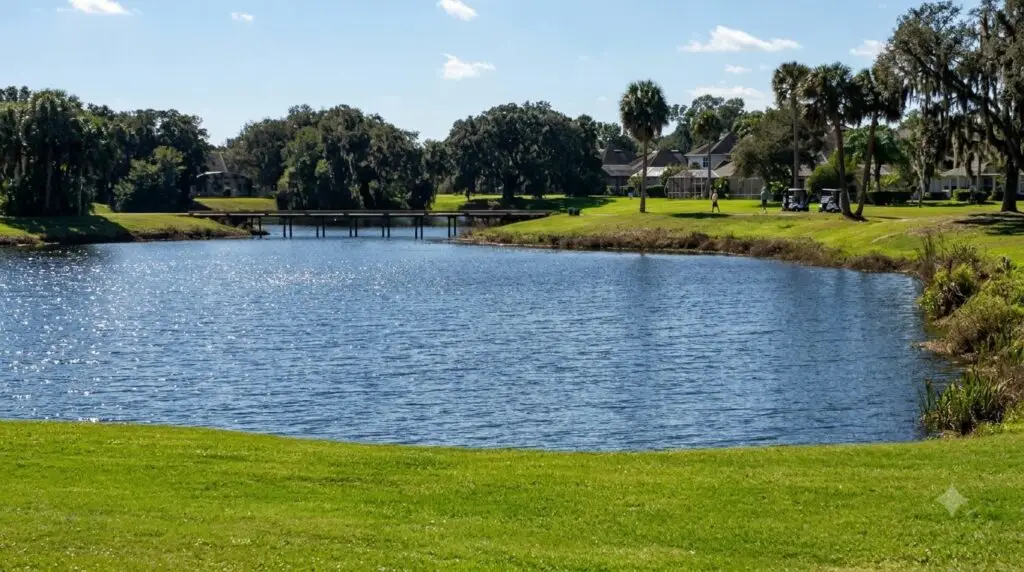
Oaks National is a longtime staple of Osceola County golf. Its signature is the setting: 100-year-old oak trees, graceful sloping fairways that wind around bodies of water, and wildlife like wild turkey, heron, eagles and hawks along the way.
That setting shapes strategy. The fairways aren’t flat corridors from tee to green, and water and trees change how each hole wants to be played. On an unfamiliar course, many golfers simply hit driver as far as possible and deal with what comes next. Here, a thoughtful approach pays off more.
Your first-round goal should be simple: learn the course rather than trying to beat it. Where does the fairway open up? Which side sets up the better approach? Where can you safely miss? Answering those questions now pays off in every round that follows. Read more about the course and scorecard.
Before You Arrive
Book Your Tee Time
Check availability and book your tee time in advance rather than assuming you can walk on, especially if you’re coordinating a group or playing during a busy travel period. When choosing a time, think about travel time, how long you like to warm up, the season’s heat and daylight, and your plans after the round. Review current pricing on the rates and fees page.
Visiting the area? See our guides to tee times near Disney World, planning a golf vacation in Orlando and playing twilight golf after 3 p.m.
Check the Weather and Pack for Florida
Central Florida golf can bring heat, humidity, strong sun and passing rain depending on the season and time of day. Check the forecast and pack:
- Sunscreen, sunglasses and a hat or visor
- Water and electrolytes, and start hydrating before the round
- A towel and an extra glove for humid or wet conditions
- Rain gear or an umbrella when the forecast calls for it
- Lightweight, breathable clothing
Learn how conditions change your game in our guide to how weather and turf affect performance.
Check Your Equipment
Make sure every club is in the bag, your shoes are ready, your rangefinder or GPS is charged, and you have enough balls, tees, a divot tool and a ball marker. With water in play, pack a few extra balls. It’s better to finish with spares than to borrow on the closing holes.
Arrive Early and Warm Up
For a first visit, arriving about 45 to 60 minutes before your tee time is a practical target. It gives you time to check in, find your way around, organize your gear and warm up without rushing. Follow any specific arrival guidance the club gives you.
Oaks National’s practice facility makes warming up easy. The goal isn’t to rebuild your swing. It’s to find the swing you brought with you today.
- Start with short clubs. Make controlled swings with wedges and short irons to find rhythm, contact and balance.
- Work up to longer clubs. A handful of purposeful drives is more useful than half a bucket chasing extra yards.
- Practice your normal shot shape. Right before a round isn’t the time to debut a new tee shot.
- Spend time chipping. Everyone misses greens, and comfortable chips turn misses into manageable scores.
- Finish on the putting green. Focus on speed from several distances, then roll in a few three- to five-footers for confidence.
Choose the Right Tees
Oaks National offers four sets of tees, so pick based on your game, not ego, age or what your partners play. Consider your driving distance, accuracy, handicap and comfort with long approach shots. If you’d be hitting fairway woods or long hybrids into most par 4 greens, move forward. That isn’t surrender. It brings the hazards and landing areas into play the way the design intended.
Not sure where to start? Use our guide to choosing tees by 7-iron distance, and learn how course rating, slope and tee boxes work. Look over the scorecard before you tee off too. Note the longer par 4s, the par 5s that need three-shot planning and the par 3s that may need more club than you expect.
Course Management for Your First Round
Read What the Water Is Asking
Water can change your decisions before it’s even in play. Golfers see it and start steering their swings. Instead, turn the reaction into a decision:
- Is the water actually in range?
- Which side is the safer miss?
- Do I need driver here?
- Can I comfortably carry the hazard?
- Would laying back leave an easier next shot?
Laying back isn’t automatically right either. If the safer play leaves a very difficult approach, taking more distance off the tee may still be the better choice.
Respect the Oak Trees
The oaks give the course its character, and they also shape your next shot. A ball sitting nicely in the rough can still leave a tough approach if branches block your line. If one side of the fairway brings the trees into play, favor the other side, even if it means a slightly longer approach. Distance management asks how far you can hit it. Course management asks where to hit it so the next shot gets easier.
Choose Control When Distance Brings Trouble Closer
Driver doesn’t automatically belong on every par 4 and par 5. Compare two options: driver leaves 125 yards but brings real trouble into play, while a fairway wood leaves 150 yards from a wider landing area. If you’re confident from 150, the second option may produce better scores over time. Be aggressive where extra distance creates a real advantage, and choose control where it mostly brings hazards closer.
Play to Your Favorite Number
If you’re comfortable from 100 yards but not from 50, don’t blast your second shot on a par 5 you can’t reach in two. Work backward and pick the club that leaves your preferred yardage. Instead of asking how close you can get, ask where you want your next shot to come from.
Aim for the Center and Know Your Safe Miss
When you don’t know the greens yet, the middle of the green is a great target. Tucked pins near trouble turn decent shots into bunker or water recoveries. Before every important shot, ask where you can afford to miss, then aim so your normal dispersion favors that side. Planning for your misses is more realistic than planning for perfection.
Pick Safe Targets, Then Swing With Commitment
Conservative golf doesn’t mean tentative golf. Aiming at the wider half of a fairway is strategy. Decelerating because you’re nervous about water causes trouble. Make your decisions before the swing, not during it. Our guide to the psychology behind smart course management goes deeper.
Take Your Medicine After a Mistake
If your drive ends up behind the trees, the low hook through a tiny gap rarely works. Pitching back into a playable position and accepting a bogey usually beats turning one bad swing into three. Ask which shot gives you the best chance of getting back to normal play.
During the Round
Let the first few holes come to you. Use the opening holes to gather information: ball flight, carry distance, green speed, wind and how far the ball is rolling. Maybe your irons are flying farther than expected or the greens are quicker than they felt in warm-up. Adjust as you go.
Keep pace. You don’t need to rush, but be ready. Plan your shot while others play, read your putt while others putt, and carry an extra ball when searching. Brush up with our guide to essential golf etiquette.
Set a realistic goal. Don’t make your first round about a career score. Aim to avoid penalty strokes, pick smart targets, commit to every shot and learn the layout. If you leave knowing how you’d play a few holes differently next time, the round did its job. Even skilled players misjudge landing areas or pin positions on a new course, and that knowledge becomes your advantage the next time.
Ask the golf shop. The staff can tell you about current course conditions or anything that’s changed. Call 407-483-3700 if you have questions before your visit.
After the Round: Relax at The Oaks Café
Your golf day doesn’t have to end on the 18th green. The clubhouse is built to start and finish your round, with food and beverages at The Oaks Café, flat-screen TVs throughout the seating area and a covered outdoor patio. Grab lunch and a cold drink, and talk through the round with your group. Stop by the golf shop for apparel, accessories or a gift.
Your First-Round Checklist
Before the day: book your tee time, check the forecast, confirm travel time and check your equipment.
Pack: extra balls, tees, sunscreen, water, a towel, an extra glove, rain gear if needed and a charged GPS or rangefinder.
At the course: arrive early, check in, choose your tees, warm up progressively, chip and practice putting speed.
On the course: favor smart targets, respect water and tree angles, know your safe miss, skip the hero shots, keep pace, stay hydrated and adjust to conditions.
Love the course after your first round? Ask about Oaks National’s PDP membership, billed as the Orlando area’s most affordable golf membership. If you’re newer to the game, read our beginner’s guide to golfing at Oaks National, or explore golf lessons in Orlando.
Before you arrive, review our beginner’s guide to golf etiquette, then book your first tee time online.
Frequently Asked Questions
What are Oaks National Golf Club’s hours?
Oaks National is open Monday through Sunday from 7 a.m. to 5 p.m. Book online through the tee times page or call 407-483-3700.
Has Oaks National Golf Club won any awards?
Yes. Oaks National was named one of GolfAdvisor’s 2016 Top 25 Most Improved Courses in the U.S., following its complete rebrand in 2015.
Prepare Smart and Enjoy Your First Round
Your first round at Oaks National Golf Club shouldn’t feel like an exam. It should feel like discovering a new course. Karl Litten’s layout rewards golfers who think about where the ball should finish, not just how far it can go.
Book ahead, arrive with time to settle in, use the practice facility, pick tees that fit your game and pay attention to what the course tells you. You’ll probably misread a putt or pick the wrong club somewhere. That’s golf. Play with sensible targets, committed swings and realistic expectations, and your first round becomes the start of knowing the course, not just playing it once.
Ready to play? Book your tee time or contact the golf shop.
Oaks National Golf Club
1500 The Oaks Blvd, Kissimmee, FL 34746
407-483-3700 | proshop@oaksnationalgolfclub.com
Open daily, 7 a.m. to 5 p.m.