
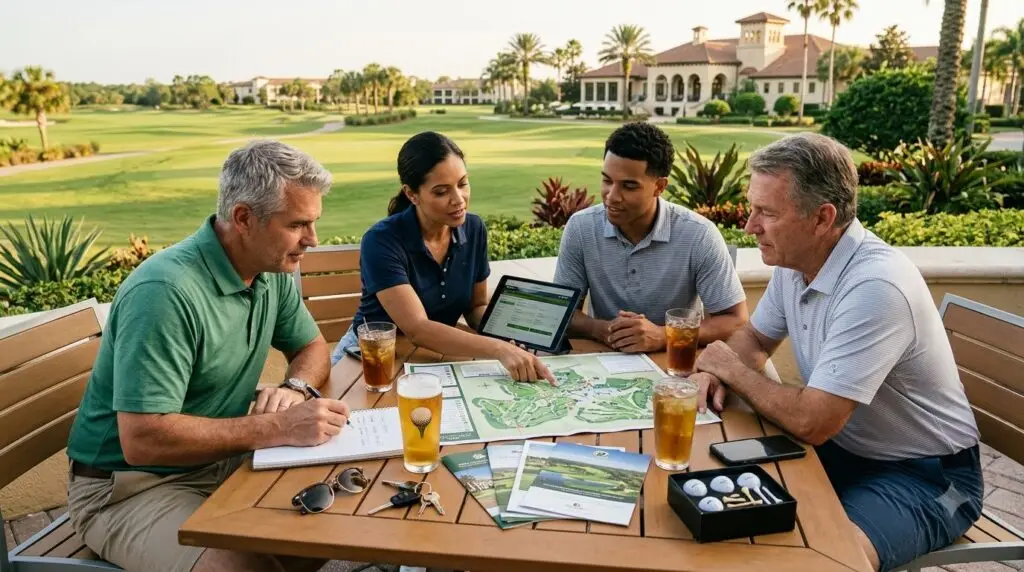
A successful golf outing requires more than reserving several tee times.
The organizer must coordinate player ability, budget, course format, carts, food, registration, weather, transportation, prizes, and post-round activities. For corporate and charity events, branding, sponsorship, scoring, and guest experience may also be important.
Kissimmee works well for group golf because the area combines golf courses, resorts, vacation rentals, meeting venues, restaurants, and nearby Central Florida attractions. The official destination guide highlights courses such as Reunion Resort, Mystic Dunes, Celebration Golf Club, Falcon’s Fire, Kissimmee Bay, and other options across the area.
The best venue, however, depends on the event you are planning.
A client-appreciation day may require strong hospitality and private dining. A friends’ trip may prioritize price and convenient lodging. A charity tournament may need a shotgun start, sponsor signage, scoring support, and enough space for an awards ceremony.
This guide explains how to plan a golf outing in Kissimmee that fits your guests, goals, and budget without adding unnecessary complexity.
Quick Planning Framework
Before contacting courses, decide five things:
- Why are you organizing the outing?
- How many golfers and non-golfing guests may attend?
- What is the maximum total budget?
- Are participants beginners, experienced golfers, or a mixture?
- What should guests experience before and after the round?
These answers determine whether you need consecutive tee times, a tournament package, a scramble, private dining, overnight accommodation, or only a straightforward group reservation.
What Type of Golf Outing Are You Planning?
Corporate or Team Event
A company golf outing may be used for:
- Employee recognition
- Team interaction
- Leadership retreats
- Department celebrations
- Partner engagement
- Informal networking
The event should not rely on golf ability alone. Mixed-skill teams, a beginner-friendly format, optional instruction, and a comfortable post-round gathering can make the experience more inclusive.
Client Appreciation Event
A client event should prioritize hospitality and relationship-building.
Consider:
- Personalized invitations
- Logical pairings
- Easy arrival and registration
- Food and beverage service
- Modest branded gifts
- Time for conversation after the round
- A schedule that respects the client’s time
Avoid turning every hole into a sales presentation. The business value comes from creating a thoughtful experience, not trapping guests inside a four-hour pitch deck wearing golf shoes.
Friends or Family Outing
A social outing usually needs less formality but still benefits from organization.
Confirm:
- Date and final headcount
- Skill levels
- Shared transportation
- Rental-club requirements
- Payment deadline
- Room arrangements
- Competition format
- Dinner or post-round plans
For a small group, consecutive tee times may be easier and less expensive than a formal tournament package.
Charity Tournament
A fundraiser requires the most planning because the golf operation must work alongside registration, sponsorship, donations, volunteers, prizes, and financial reporting.
A charity event may need:
- Player registration system
- Sponsor packages
- Hole signage
- Donation collection
- Volunteer assignments
- Contests
- Scorekeeping
- Auction or raffle management
- Post-round program
- Clear accounting procedures
Check Florida laws and venue rules before running raffles, games of chance, alcohol promotions, or prize drawings.
Step 1: Define the Event Goal
Write one primary objective.
Examples include:
- Thanking 24 important clients
- Raising a defined amount for a nonprofit
- Giving employees an informal team experience
- Organizing a low-stress weekend for 12 friends
- Creating networking opportunities for industry partners
The objective prevents unnecessary spending.
A friends’ outing probably does not need custom banners on every tee. A sponsored charity tournament may depend on those placements to generate revenue.
Also define how success will be measured.
Possible measures include:
- Attendance
- Guest satisfaction
- Funds raised
- Sponsor renewals
- Qualified business conversations
- Employee participation
- Cost per guest
- Repeat-booking interest
Step 2: Estimate the Group Size
Do not treat an invitation list as a confirmed player list.
Track:
- Invited golfers
- Confirmed golfers
- Waitlisted golfers
- Non-playing guests
- Sponsors
- Volunteers
- Vendors
- Course and event staff
Some venues treat 12 or more golfers as a formal group and offer dedicated planning support. Reunion Resort, for example, currently promotes group golf planning for groups of 12 or more. Each course sets its own minimums and package rules.
Ask the course:
- What qualifies as a group?
- How many players are needed for an outing package?
- Is a deposit required?
- When is the final player count due?
- What happens if attendance decreases?
- Can non-golfing guests attend the meal?
- Is the organizer responsible for unused spaces?
Build the contract around a realistic number, not the most optimistic response to a save-the-date email.
Step 3: Choose the Right Venue
Course reputation matters, but event fit matters more.
Evaluate these areas.
Location and transportation
Check travel time from:
- Hotels or vacation rentals
- Airports
- Meeting venues
- Corporate offices
- Planned restaurants
- Other group activities
Use estimated travel times for the actual day and hour of the event. Central Florida traffic can turn a short distance into a late arrival.
Course difficulty
A difficult course may appeal to experienced players but frustrate beginners and slow the event.
Ask about:
- Tee options
- Course length
- Carry requirements
- Pace expectations
- Beginner suitability
- Rental clubs
- Practice facilities
- On-course assistance
Event support
Some Kissimmee-area courses advertise services such as pairings, cart staging, scoring, signage, food, and beverage coordination. Orange Lake Golf, for example, promotes these services for corporate, charity, and social outings.
Ask which services are included and which require an additional fee.
Food and gathering space
Determine whether the course offers:
- Breakfast
- Boxed meals
- Beverage carts
- Post-round lunch or dinner
- Private room
- Outdoor reception area
- Awards setup
- Dietary accommodations
ChampionsGate’s official Kissimmee venue listing, for example, describes customizable food and beverage services for group outings.
Overnight accommodation
A resort may be useful when participants are travelling.
Reunion Resort combines group golf with room blocks and vacation homes, while Kissimmee’s tourism organization lists a wide range of meeting properties and group venues.
Compare the convenience against resort pricing, transportation, and minimum commitments.
Step 4: Select the Right Golf Format
Scramble
In a scramble, each player hits a shot, the team selects its preferred result, and everyone plays the next shot from that position.
This format works well for:
- Mixed skill levels
- Corporate events
- Charity tournaments
- Groups prioritizing teamwork and pace
The USGA recognizes scramble as a distinct team format and provides recommended handicap allowances when handicaps are used.
Best Ball
Each player plays their own ball through the hole. The lowest score among the team members becomes the team score.
Best ball suits experienced players who want to complete their own round while competing as a team.
Shamble
Every player hits a tee shot, the team selects the best drive, and players then complete the hole using their own balls.
The USGA defines a shamble using this best-drive structure.
It offers more individual golf than a scramble while reducing pressure from difficult tee shots.
Individual Stroke Play
Each golfer records their own total score.
Use this for experienced groups that understand the rules and are comfortable with a more competitive event.
Shotgun Start
Groups begin on different holes at approximately the same time.
This helps participants finish within a similar window, making a shared meal or awards ceremony easier to schedule.
A shotgun start depends on course approval, group size, time, and available inventory. Do not advertise one before the venue confirms it in writing.
Consecutive Tee Times
For smaller outings, reserving tee times one after another may be the simplest model.
It usually requires less event infrastructure, although the first and last groups may finish far apart.
Step 5: Build the Full Budget
Use:
Total event cost =
Golf and cart fees
+ practice access
+ food and beverages
+ venue or tournament services
+ prizes and gifts
+ branding and signage
+ transportation
+ photography or entertainment
+ taxes and service charges
+ contingency reserve
Ask whether the proposal includes:
- Green fees
- Shared carts
- Range balls
- Scorecards
- Bag handling
- Cart signs
- Scoring
- Registration tables
- Contest markers
- Food gratuity
- Beverage service
- Taxes
- Rental clubs
- Room rental
- Weather rescheduling
A package with a higher starting price may offer better value when staffing, food, scoring, and event setup are included.
Budget by event type
| Event | Highest-priority spending |
| Friends’ outing | Golf, carts, transportation, meal |
| Client event | Hospitality, smooth coordination, thoughtful gifts |
| Employee event | Inclusive format, food, team experience |
| Charity tournament | Fundraising tools, sponsors, volunteers, awards |
| Destination group | Accommodation, transportation, rentals, itinerary |
Add a contingency amount for attendance changes, extra meals, rentals, weather adjustments, and last-minute materials.
Step 6: Create Fair and Enjoyable Pairings
Pairings affect the tone of the day.
For corporate and client events, consider:
- Relationship goals
- Job seniority
- Existing connections
- New introductions
- Playing ability
- Personality
- Conflicts of interest
- Guest preferences
Avoid placing every strong golfer together while beginners struggle elsewhere.
For a scramble, balance teams using handicaps or honest ability estimates. Keep one or two backup pairing plans in case players cancel.
Ask participants during registration for:
- Handicap or average score
- Rental requirements
- Food restrictions
- Accessibility needs
- Preferred teammates
- Whether they are comfortable playing with beginners
Step 7: Plan the Guest Journey
A polished outing has a clear flow.
Before the round
Provide:
- Parking and arrival instructions
- Registration time
- Dress code
- Rental information
- Event format
- Schedule
- Weather policy
- Contact number
At check-in, guests should know where to leave clubs, collect materials, find refreshments, and meet their group.
During the round
Possible additions include:
- Closest-to-the-pin contest
- Longest-drive contest
- Team photo location
- Sponsor activities
- Beverage stations
- On-course food
- Rules sheet
- Emergency contact details
Keep contests simple. Too many activities can slow play and turn the course into an obstacle course wearing logo stickers.
After the round
Allow enough time for:
- Score collection
- Refreshments
- Meal service
- Awards
- Sponsor recognition
- Charity presentation
- Group photographs
- Transportation departure
Keep speeches brief unless the event has a formal fundraising or business program.
Step 8: Create a Weather and Safety Plan
Florida golf is available throughout much of the year, but outdoor events still need a weather plan.
The National Weather Service recommends that organized outdoor activities create and follow a lightning safety plan. Organizers should identify safe shelter, determine who monitors conditions, define suspension procedures, and communicate the plan before the event.
Confirm with the course:
- Who decides when play stops?
- Where do players shelter?
- How are groups notified?
- What is the rain-check policy?
- Can food or awards continue indoors?
- What happens if fewer than nine holes are completed?
- Is rescheduling available?
- Which costs are nonrefundable?
During warmer months, also plan for:
- Water
- Sunscreen
- Heat-sensitive guests
- Cooling areas
- Medical needs
- Earlier tee times
Never pressure guests to continue during lightning or unsafe conditions.
Planning Timeline
Three to Six Months Before
- Define goals and budget
- Estimate group size
- Contact suitable courses
- Compare proposals
- Select the date and format
- Sign the agreement
- Reserve accommodations if required
- Approach sponsors for charity events
One to Three Months Before
- Send invitations
- Open registration
- Collect payments
- Confirm food
- Order prizes and signs
- Arrange rentals
- Build initial pairings
- Confirm transportation
- Share sponsor requirements
Two Weeks Before
- Review registrations
- Confirm dietary and accessibility needs
- Submit preliminary player count
- Finalize contests
- Review the weather process
- Prepare guest communication
- Assign staff and volunteers
Final Week
- Submit final player list
- Confirm pairings and carts
- Verify meals
- Check rental sets
- Print registration materials
- Reconfirm venue contacts
- Prepare a backup schedule
Event Day
- Arrive before guests
- Test registration
- Confirm signage and contests
- Review safety procedures
- Welcome players
- Keep the event on schedule
- Collect scores
- Thank guests, sponsors, and staff
Common Planning Mistakes
Choosing a course before understanding the group
A demanding layout may be wrong for a beginner-heavy corporate outing.
Better approach: Match the venue and format to the participants.
Comparing only green fees
A lower rate may exclude carts, scoring, food, staff, or event space.
Better approach: Compare complete proposals.
Inviting guests before confirming capacity
The chosen date may not support the required number or format.
Better approach: Place a venue hold before distributing formal invitations.
Assuming a shotgun start is included
It may require a minimum number of golfers, course buyout, or specific time.
Better approach: Confirm availability and cost in writing.
Leaving pairings until event morning
Last-minute pairings create confusion and weaken networking goals.
Better approach: Prepare a primary and backup pairing plan.
Ignoring beginners
An event built only around experienced golfers can make other guests feel stranded.
Better approach: Use a scramble, practice session, clinic, or shorter option.
Having no lightning plan
A vague promise to “watch the weather” is not sufficient.
Better approach: Establish authority, shelter, communication, and restart procedures.
Overloading the schedule
Excessive contests, speeches, branding, and activities create delays.
Better approach: Choose a few elements that support the event objective.
Frequently Asked Questions
How far in advance should I plan a golf outing in Kissimmee?
Begin several months ahead for corporate, charity, resort, or large group events. A small friends’ outing using consecutive tee times may require less planning, depending on season and availability.
What is the best format for mixed-skill golfers?
A scramble is usually the most accessible option because team members play from the selected best shot. It reduces pressure on beginners and encourages interaction.
How many golfers are needed for a group outing?
Venue policies differ. Some courses provide group services beginning around 12 players, while formal tournaments or shotgun starts may require substantially more. Confirm minimums directly with the course.
What should a golf-outing budget include?
Include golf, carts, food, beverages, event services, prizes, signage, rentals, transportation, taxes, gratuity, and a contingency reserve.
Can non-golfers attend?
Many venues allow non-golfing guests to attend meals or post-round activities. Ask about guest charges, room capacity, and whether riders are allowed on the course.
What happens if it rains?
The course’s contract determines whether the event is delayed, shortened, credited, rescheduled, or refunded. Review weather terms before paying a deposit.
Is Kissimmee suitable for a destination golf group?
Yes. Kissimmee combines golf courses, resorts, vacation rentals, meeting venues, dining, and nearby attractions, which can support groups that want activities beyond the round.
What information should be sent to guests?
Send the address, arrival time, dress code, schedule, rental instructions, event format, food details, weather plan, payment status, and organizer’s contact information.
Final Takeaway
A successful golf outing in Kissimmee begins with the people attending, not the course brochure.
Define the event goal, estimate the real group size, choose an inclusive format, compare complete venue proposals, and plan the guest experience from arrival through departure.
The essential decisions are:
- Event purpose
- Venue and course fit
- Group size
- Playing format
- Total budget
- Pairings
- Food and hospitality
- Weather safety
- Communication
- Post-round experience
When these pieces work together, the event can feel relaxed for guests even though the planning behind it is carefully structured.
Plan Your Kissimmee Golf Outing
Kissimmee offers options for corporate events, charity tournaments, client entertainment, friend groups, and destination golf trips. Local venues advertise combinations of golf coordination, food and beverage services, accommodations, scoring, signage, and event space, but inclusions and minimums vary by property.
Before selecting a course, request a written proposal covering the final cost, event format, player minimums, food, booking deadlines, cancellation terms, and weather policy.
The best golf outing is not the one with the most banners or prizes. It is the one where guests know where to go, enjoy the format, feel looked after, and leave interested in playing together again.